
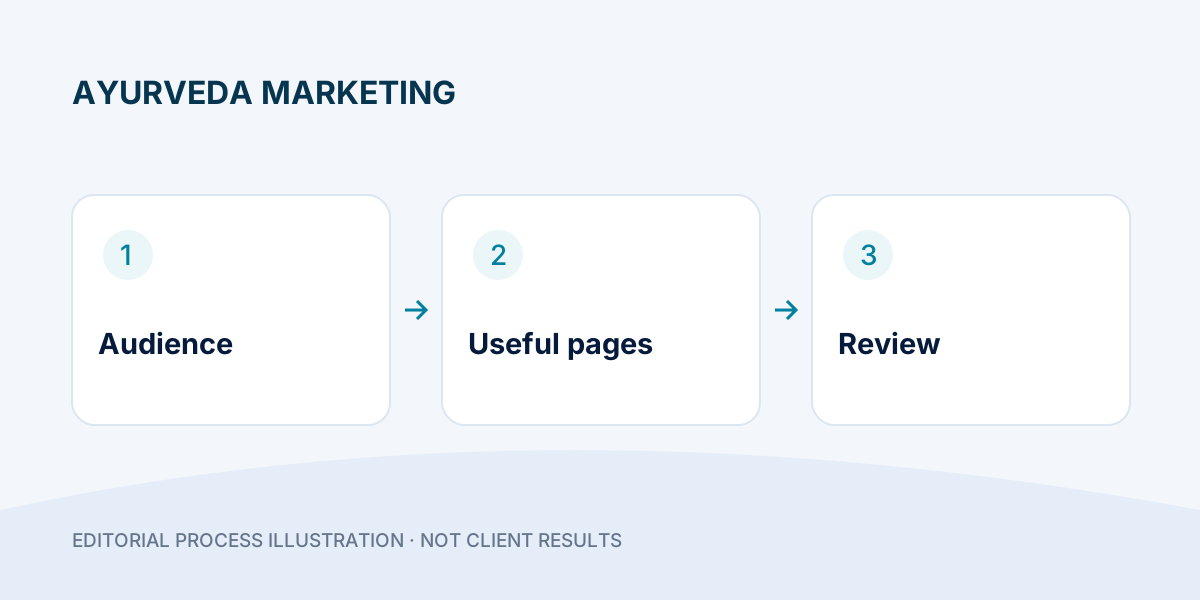
Plan an India-wide site around buyer decisions, without duplicate city pages.
- Map questions to category, product, delivery or support pages.
- Separate actual fulfilment coverage from invented local presence.
- Choose a reviewable bilingual publishing order.
An Ayurvedic medicine brand may serve customers across India without operating a physical office in every city. Its website should explain that real model clearly. National SEO is a content and website discipline: organise useful information, make product pages easy to understand, and help a visitor complete a legitimate next step. Creating hundreds of city-name pages is not a substitute for that work.
Step 1: define what the business can actually fulfil
List the products you currently sell, the enquiries your team can handle, and the delivery locations your operations team has confirmed. Separate retail orders, dealer enquiries and consultation requests. Do not present an enquiry form as an immediate confirmed sale or appointment. If delivery needs a postcode check, make that step visible rather than promising universal availability.
Write one clear sentence describing the business. For example, a hypothetical online Ayurveda brand could say that it offers a named product range with delivery availability confirmed during enquiry. That is a planning example, not a statement about DigiFlyX or a verified client.
Step 2: group questions by the decision a visitor needs to make
Use questions already received by your team, removing names, contact details and personal health information. Group them into product identity, pack comparison, availability, ordering, shipping, authenticity and support. Keep health questions out of a marketing writer's answer queue unless an appropriately qualified reviewer is responsible for them.
Create a small topic map. A category page helps a visitor browse a range; a product page explains a particular pack; a delivery page answers fulfilment questions; a guide explains how to read the information. Each page should have a clear job. Several pages repeating the same general paragraph make maintenance harder without helping the buyer.
Map the question to the page, not the keyword to a city
| Buyer question | Best starting page | Evidence needed |
|---|---|---|
| Which packs does this range contain? | Category overview | Current range and meaningful pack differences. |
| Is this the pack I saw on the label? | Specific product page | Correct product identity and readable pack image. |
| Can it reach my area? | Delivery or availability information | Confirmed fulfilment process and exceptions. |
| I need help with an existing order. | Customer support route | The actual support process, not a new-sales form. |
These are planning examples, not evidence that your business already has each page. Merge questions that need the same answer; separate pages only when the visitor's task genuinely changes.
Step 3: build a simple internal link structure
Start with a small number of genuine product categories. Link each category to its available products and connect useful guides to the relevant category. Use descriptive link labels such as the product range or guide topic. Avoid sending every link to a generic enquiry page when the reader needs detailed information first.
For a service-led Ayurveda business, link the guide to the actual service page and explain the next step there. A focused landing page can support this journey. Paid lead generation is a separate acquisition channel; buying ads does not itself prove or guarantee organic rankings.
Step 4: publish a complete language version
Choose languages according to the people your team can serve. A Hindi page should explain the full subject naturally, including product context, ordering limits and the next action. It should not contain an English article with only a Hindi heading. Have a reader check terminology that can change meaning in translation.
Keep a visible language link on the corresponding page and have the website team connect the correct equivalents. Maintain both versions when products, delivery information or contact processes change. Do not silently send a Hindi visitor to an unrelated English homepage.
Step 5: use location pages only when they add real information
A genuine retail branch may need its own address, hours and visit instructions. A national online brand can instead explain its real fulfilment process. Avoid invented offices, local phone numbers that imply a branch, and near-identical city pages created only to funnel visitors to the same destination. Google's spam policies describe doorway abuse and scaled content created primarily to manipulate search.
Step 6: review content and measurement together
Keep a publishing sheet with page purpose, owner, language, factual source and review date. Measure enquiry quality alongside visibility. If a guide receives visits but people ask the same unanswered question, improve the explanation before creating another article. Check broken links, unavailable products and outdated fulfilment instructions during the same review.
Google encourages content that primarily helps people. Use its people-first content guidance as a review prompt, not as a checklist that guarantees placement. A working public website and proper indexing are prerequisites; a private localhost preview cannot gain public search visibility.
A practical publishing worksheet
- Choose one real buyer question and the product or service it relates to.
- Write the answer from approved business facts, with no cure promise.
- Add the relevant product, category or enquiry link.
- Prepare the complete Hindi and English versions that you can maintain.
- Record the owner and review date; check the page on a phone.
- Review search interest and legitimate enquiries after publication.
Frequently asked questions
Can we say we serve all India?
Only to the extent that actual fulfilment supports it. Explain exceptions and availability checks instead of implying unrestricted delivery.
Do we need a separate article for every city?
No. Start with distinct questions and real locations. A city label alone is not a useful new topic.
How quickly will organic enquiries arrive?
There is no fixed promise. Site readiness, competition, content usefulness and other factors matter. Discuss a realistic content plan based on your actual Ayurveda products and team capacity.
Try it: build a five-question page map
Take five recurring non-sensitive questions from your team. For each, write: question → existing page or missing answer → approved fact source → next useful link. Two questions may belong on the same page. Do not create five articles automatically.
Choose the unanswered question that blocks a legitimate next action, such as identifying the correct pack or confirming delivery. Assign one owner to supply the missing facts and another to check both languages. Your output is a short page map and a review task—not a city-page count or a ranking promise.