
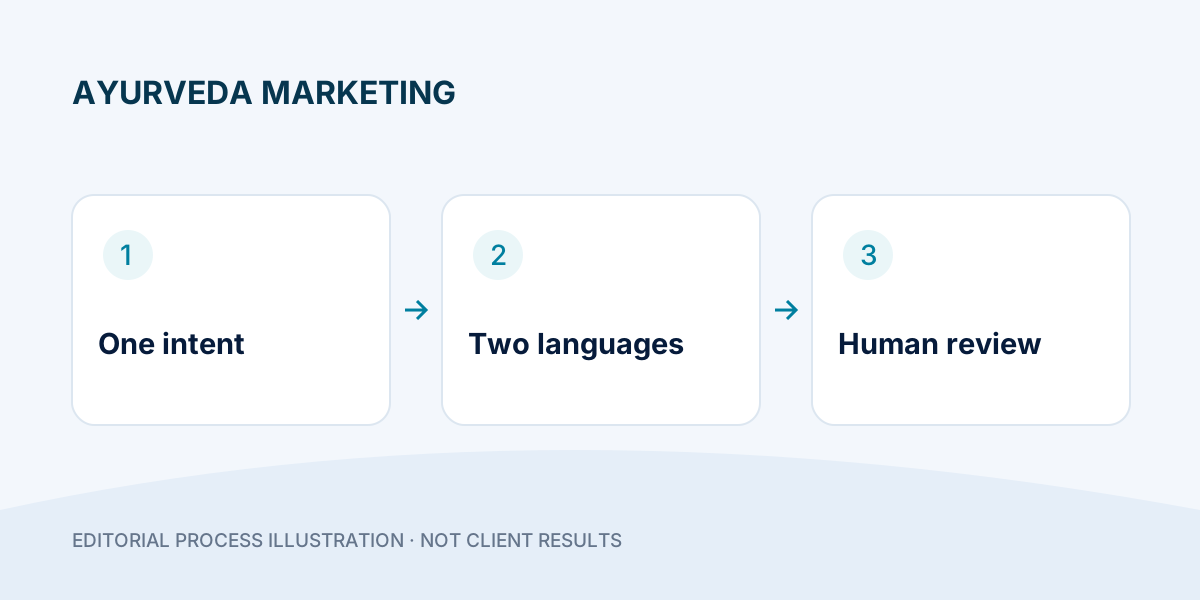
Keep facts and next actions equivalent across Hindi and English without awkward literal translation.
- Build one shared fact sheet and short terminology list.
- Spot a translation that accidentally strengthens a promise.
- Check the matching article and service destination in both languages.
An Ayurveda medicine brand serving people across India may receive the same buying question in English, Hindi and mixed conversational language. Publishing two versions is useful when each reader gets a complete answer. Translating only the headline or repeating a sales paragraph with different city names does not solve that problem. Start with a small, maintainable set of topics and make the information equally usable in both languages.
Step 1: Collect questions without collecting private health stories
Ask the sales and support team to list recurring non-sensitive questions: available pack information, where to find ingredients on the label, delivery information, how to contact the business and how a retailer can request commercial details. Record the question, not the customer's identity or medical history. Group equivalent Hindi and English questions together so you can see the underlying need.
Mark whether the reader is a consumer, retailer or another genuine audience your business serves. A consumer information page should not suddenly switch into a bulk-purchase pitch. Choose the audience before choosing the headline.
Step 2: Make a shared fact sheet, then translate
Separate fixed facts from wording choices. The fact sheet holds the product name, pack unit, source revision, delivery qualifications and approved next action. Keep missing or unreviewed information visibly pending. Neither writer should fill a gap independently.
Start a short glossary with the expressions the team repeats: enquiry, pack size, availability, retailer and contact. Keep brand and product spellings consistent; explain an unfamiliar term in plain Hindi. Review numbers and conditions separately from style. A smooth sentence that removes “after checking” has changed the promise.
Step 3: Test equivalent meaning with a real reading task
Give both readers the same task, such as finding where to ask about a pack. Each version must supply the same necessary facts and route. Hindi readers should not need the English page to discover a limitation, and English readers should not receive a shortened sales pitch.
Ask a colleague to say what the article promises and what action it asks for. Compare that answer with the source brief. If it sounds stronger or different, revise the wording before debating the headline. The comparison table below shows two common meaning changes that a spelling check will not catch.
Step 4: Give each version a real destination
Use separate, accessible language URLs and a visible language selector that opens the matching article. A reader should not lose the topic and land on the homepage after selecting Hindi. Google recommends identifying alternate language versions and linking the language set reciprocally, including each page itself. Its localized-page guidance explains the technical implementation.
Ask the developer to check the rendered page language, title, description, canonical and alternate-language URLs together. These are implementation details for accurate discovery, not a promise of rankings. Test with JavaScript disabled where practical so the article and its normal links remain available.
Step 5: Keep location information truthful
Serving customers across India does not mean having an office in every city. Do not replace a city name in the same article and publish dozens of near-identical pages. If a location needs its own information, it should answer a genuine different question using verified business facts, such as an actual service area or real contact arrangement. Otherwise, one clear India-wide page is easier to maintain and less misleading.
Likewise, do not add a regional-language claim unless the team can actually provide that content or support. Start with complete Hindi and English journeys, then expand when there is evidence of demand and someone can maintain the additional language.
Step 6: Review the whole journey, not only the article
Open the article on a phone, switch language, follow its service link and read the destination. Product names, availability wording and next actions should agree. If the destination is English-only, label the action clearly instead of implying a Hindi experience that does not exist. Check menus, captions, image alternatives and error messages when they are part of the journey.
A simple review record can track topic, language, responsible editor, source revision and last factual review. When packaging or a business policy changes, update both versions from the same change note. Do not silently leave the Hindi version on obsolete facts.
Step 7: Improve the editorial system from real questions
Review repeated unanswered questions with the team. Add a missing explanation to the relevant article instead of publishing another nearly identical post. Use feedback to clarify language, shorten confusing instructions and connect the right page. Avoid equating more published pages with more useful information.
Explore landing-page support for a clearer reading journey, or video creatives when a visual explanation better fits the question.
Common questions
Is word-for-word translation necessary?
No. Preserve factual meaning, qualifications and actions. Natural phrasing can differ while giving both readers equivalent information.
Can Hindi and English share the same product pictures?
Yes, when the picture accurately represents the same product. Translate explanatory captions and avoid editing a real label into a different product claim.
Do we need a page for every Indian city?
No. Build a separate page only when you have distinct, useful and truthful information for that audience. A list of cities is not evidence of local offices or service capability.
Translation check: does the promise stay the same?
Illustrative wording exercise; these are not delivery terms for any actual product. Compare meaning before polishing the sentence.
| Reviewed English | Meaning changed—reject | Equivalent Hindi |
|---|---|---|
| “Delivery availability will be checked after you share the postcode.” | “हर जगह delivery मिल जाएगी।” | “Postcode मिलने के बाद delivery availability जाँचेंगे।” |
| “Ask the team for current pack information.” | “टीम से अपने लिए सही दवा चुनवाएँ।” | “Pack की अभी की जानकारी टीम से पूछें।” |
The first rejected line turns a check into a guarantee. The second turns product information into personal treatment advice. Fluent language can still change the service being offered.
- Underline quantities, conditions, dates and action words in the source.
- Ask a second reader to explain the translated meaning without seeing the source.
- Compare the explanation, then test the link and the matching language article.
- If a product fact changes, mark both versions for review from the same change note.
Finished output: one approved pair, a five-to-ten-term glossary and a reviewer/date entry. Do not create extra city pages merely to reuse the translation.