
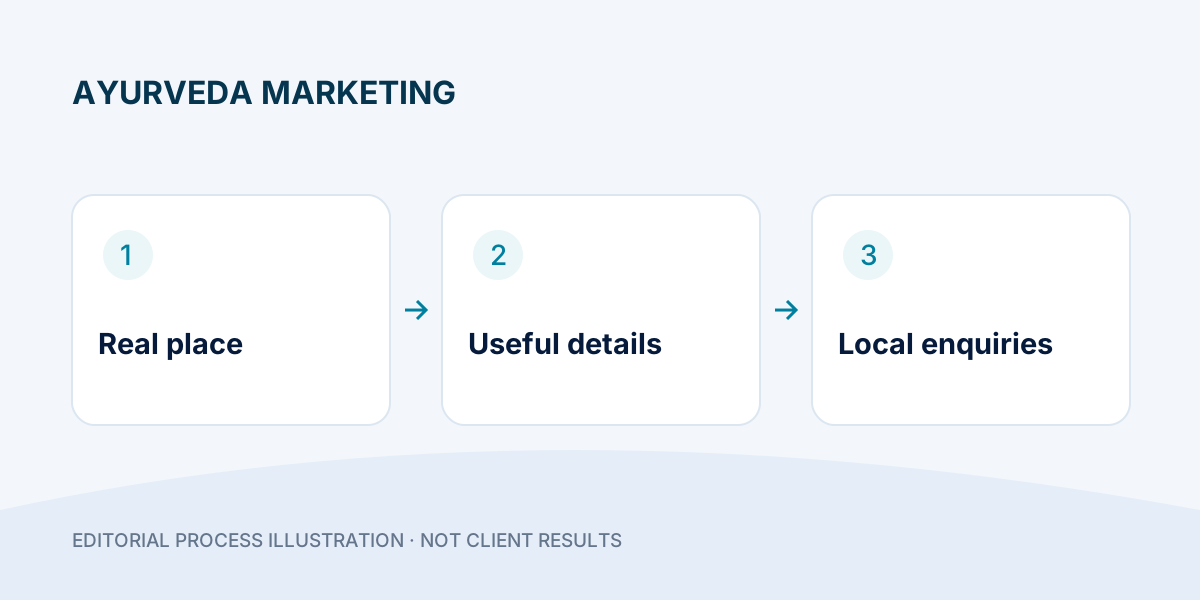
Find and fix the local information that can waste a customer's visit.
- Separate a real shop or clinic from an online-only brand.
- Reconcile conflicting address, hours and contact details.
- Test one complete mobile stock or visit enquiry.
A local Ayurveda business needs to answer a few simple questions before asking a visitor to call: where is it, when is it open, what does it actually offer, and what should someone expect next? Local SEO begins with making those answers dependable. This guide is for a real Ayurveda medicine shop, authorised retail outlet or clinic. It is a marketing workflow, not medical advice or a promise of rankings.
Step 1: confirm the business you are representing
Write down the genuine trading name, public contact details, address, customer-facing hours and the person responsible for updates. Separate a medicine shop from a consultation service when their responsibilities differ. Do not suggest that a retailer provides consultations if it does not. Record which information the owner has approved before putting it online.
Check eligibility before creating a Google Business Profile. Google generally requires in-person customer contact during stated hours and excludes online-only businesses; the owner or an authorised representative must manage the listing. Read the official eligibility and ownership guidance. Selling across India does not justify inventing a local branch in each city.
Step 2: make one accurate location record
Keep a small reference document containing the exact business name, address, map location, phone number, website link and regular opening hours. Add the process for updating holiday hours. Use this same approved information on the website and relevant business listings. If a shop moves, update the real record instead of leaving two apparently active locations.
Check the address as a visitor would. Is the entrance identifiable? Is the stated building or floor correct? Are pickup and consultation hours different? Describe real access instructions without publishing private home details or implying facilities that have not been checked.
Resolve disagreements before copying the record
If the website says Sunday is open but the shop is closed, do not choose the answer that looks more convenient. Ask the person who runs the location, note the confirmation date, and update the wrong source. Keep a short discrepancy log: field, website value, listing value, approved value, owner, corrected date. Prioritise details that can cause a wasted visit—address, hours and contact number—before cosmetic wording.
Step 3: build a useful location page
Create one clear page for each genuine location that needs its own information. Include the business name, address, hours, available services, directions and a simple contact action. Use original photographs of the actual shop or reception with permission. A photograph of another outlet is not a substitute for evidence of your location.
Explain what an enquiry can achieve: checking product availability, confirming a visit, or asking about the consultation process. Keep clinical and product statements factual and properly reviewed. Do not add disease-cure promises to make the page seem more persuasive. A focused landing page should help people decide their next step without searching through repeated sales copy.
Step 4: make contact work on a phone
Test the call and contact buttons on a small screen. Ask a colleague to find the opening hours and send a non-sensitive test enquiry through an approved test process. Check that the responsible team can see where it came from. Do not collect symptoms or medical history in a public marketing form just to qualify a lead.
State when the team normally replies if that commitment is actually supported. If an enquiry arrives outside opening hours, set an honest expectation rather than pretending that a clinician or sales adviser is immediately available.
Step 5: ask for genuine feedback carefully
Invite customers to describe their actual business experience without scripting a positive review. Do not manufacture testimonials or offer a health outcome as proof of marketing quality. In public replies, discuss service issues without confirming someone's medical condition, treatment or purchase history. Move private concerns to an appropriate private channel.
Step 6: review useful outcomes
Once a week, check whether directions, calls and website enquiries are reaching the right team. Separate accidental clicks, out-of-area enquiries and genuine availability requests. Keep personal information out of a public performance report. Compare the same kinds of enquiries over time; a change in traffic alone does not prove that enquiries improved.
A simple location-page worksheet
- Identity: approved name, real location and responsible owner.
- Visit: hours, holiday-update process and clear entrance directions.
- Offer: actual products or services and the next enquiry step.
- Proof: authorised photographs and genuine feedback.
- Measurement: weekly enquiry review and a named follow-up person.
For example, a single Ayurveda shop can improve its one location page with accurate stock-enquiry instructions. It does not need dozens of near-identical neighbourhood pages. Add a separate location page only when there is genuinely distinct information to help the visitor.
Frequently asked questions
Can an online-only Ayurveda brand use a shop address it does not operate?
No. Describe the real business model and check profile eligibility. A borrowed or fictional address is not a sound local marketing plan.
Should every nearby city have its own page?
Only when there is useful, accurate and distinct local information. Swapping city names in the same text adds little value.
Does this guarantee a top Maps position?
No. This process improves accuracy and usability; visibility depends on multiple factors. Discuss your Ayurveda business if you need help turning the checklist into a practical website plan.
Try it: audit one real location
Use three columns: website says / public listing says / owner confirms. Check the name, entrance, hours, phone and enquiry destination. Label uncertain facts “needs confirmation”; do not publish a guessed correction.
Illustrative discrepancy: the website gives general opening hours while collection has a shorter window. Show both clearly instead of claiming longer availability. Give each mismatch an owner and a review date. Finish by asking a colleague to find the correct hours and entrance using only the updated public information.