ROAS is the result of several parts of the customer journey working together—tracking, offer, creative, audience, landing experience, lead quality, sales conversion and the economics of the business itself.
A campaign can generate cheap clicks or inexpensive leads and still produce a poor return if those users never become customers. The opposite is also possible: a campaign may have a higher cost per lead but generate better-qualified opportunities and more revenue.
Improving Meta Ads ROAS should therefore begin by identifying where value is being lost in the funnel and improving that stage systematically, not with random campaign edits.
Quick Answer: How Can You Improve Meta Ads ROAS?
- Fix tracking before optimizing campaigns.
- Understand break-even economics.
- Identify where the funnel loses value.
- Improve the offer.
- Test genuinely different creative concepts.
- Strengthen the first few seconds.
- Match the ad and conversion journey.
- Optimize for qualified outcomes.
- Use sales and CRM feedback.
- Test audiences systematically.
- Cut proven waste.
- Scale only after economics make sense.
What Is ROAS in Meta Ads?
Return on ad spend compares revenue attributed to advertising with the advertising cost.
Revenue Attributed to Ads ÷ Ad Spend

₹80,000 ÷ ₹20,000 = 4.0, or 4xROAS is not profit. A positive ROAS can still be unprofitable after cost of goods, salaries, agency or service costs, shipping, discounts, taxes, operational costs, refunds and sales costs.
ROAS vs ROI vs Customer Acquisition Cost
ROAS
Revenue attributed to advertising ÷ ad spend.
Used for: advertising efficiency.
CAC
Total relevant acquisition cost ÷ new customers.
Used for: cost of acquiring a customer.
ROI
Profit relative to total investment.
Used for: broader profitability.
These metrics are related, but they are not interchangeable. A dashboard should use the metric that matches the business question being answered.
Step 1: Fix Measurement Before Trying to Improve ROAS
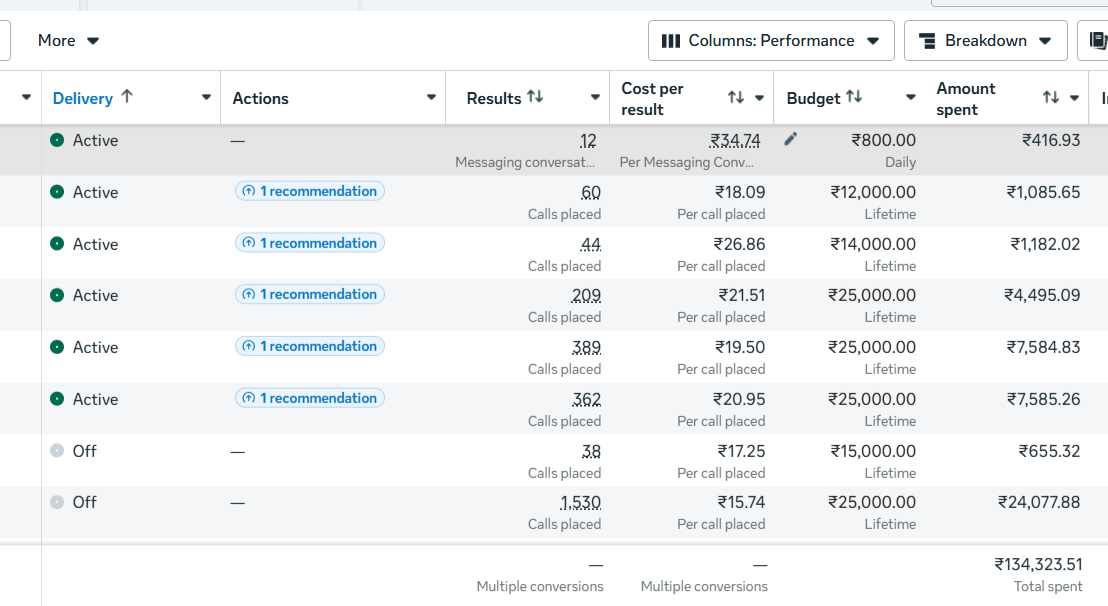
You cannot reliably optimize revenue if the business cannot connect advertising activity with customer outcomes. Where appropriate, review the Meta Pixel, Conversions API, website conversion events, UTM parameters, CRM records, lead statuses, purchase or sale events, offline sales implementation and revenue attribution.
Lead-generation companies should know which leads became qualified, booked an appointment, became customers and produced confirmed revenue. Ads Manager should not be the only data source.
Where Conversions API Can Fit
Where technically appropriate, Meta’s Conversions API can help connect marketing data from websites, servers, apps, business messaging systems or CRMs with Meta’s systems for measurement and optimization. It does not automatically improve ROAS; correct setup, consent, event quality and verification matter.
Step 2: Know What ROAS the Business Actually Needs
A “good ROAS” cannot be the same for every business. It depends on gross margin, customer value, repeat purchases, delivery and sales costs, refund rate, overhead and lead-to-customer rate.
Average sale: ₹10,000
Gross margin before marketing: 40%
Gross profit before advertising: ₹4,000
Customer acquisition cost: ₹3,500
The campaign may generate revenue, but very little margin remains. This example is not financial advice or a guarantee.
For Lead-Generation Businesses, Start With Funnel Economics
Many service businesses cannot calculate real ROAS immediately because a sale may happen days or weeks after the lead arrives.
Educational Funnel
- Ad Spend
- ₹30,000
- Leads
- 100
- Qualified Leads
- 30
- Customers
- 6
- Average Revenue
- ₹15,000
Calculated Metrics
- Attributed Revenue
- ₹90,000
- ROAS
- 3x
- Raw CPL
- ₹300
- Cost / Qualified Lead
- ₹1,000
- Ad-spend CAC
- ₹5,000
Step 3: Find Where ROAS Is Actually Breaking
Step 4: Improve the Offer Before Blaming the Algorithm
A strong creative cannot permanently rescue an offer customers do not value. A useful offer explains what the customer gets, who it is for, why it matters, the next step and what makes it credible.
Do not manufacture fake discounts or scarcity.
What Should You Test in an Offer?
Depending on the business, test an entry offer, pricing presentation, consultation, trial, genuine bonus, supportable guarantee, demo, appointment, useful lead magnet, value proposition or CTA. Change one meaningful variable where possible so the result can be interpreted.
Step 5: Improve Creative Strategy—Not Just Graphic Design
Creative performance depends on the idea and message, not only whether the design looks beautiful. A useful ad says who it is for, names a relevant problem or desire, presents the offer, gives a credible reason to believe and makes the next action clear.
Creative Angles Worth Testing
Problem-Aware
Highlight a problem the customer already recognizes.
Outcome-Focused
Show a desired outcome without unsupported promises.
Expert Explanation
A founder, doctor, consultant, trainer or specialist explains the service.
Offer-Focused
Lead with a consultation, trial, quote or appointment.
FAQ / Process
Answer an objection or demonstrate how the service works.
Genuine Proof
Use testimonials or evidence only with permission and support.
AI-Assisted Video
Use production support when it helps communicate the service clearly.
Explore DigiflyX’s existing AI Video creative service for structured creative production.
Step 6: Improve the Hook Before Rebuilding the Entire Campaign
In short-form ads, the opening should quickly signal relevance. Test a customer problem, question, contrarian insight, specific situation, expert statement, offer or visual demonstration.
Weak
“Welcome to our clinic.”
“Best gym in town.”
Stronger
“Not sure which consultation is suitable for your requirement?”
“Training regularly but still struggling to follow a structured fitness plan?”
Avoid unsupported “best” claims.
Step 7: Test Different Ideas, Not Ten Versions of the Same Ad
Weak Testing
- Same image, different button colour
- Same video, different emoji
- Same message, tiny headline change
Meaningful Testing
- Problem-focused video
- Expert explanation
- Offer-focused static
- FAQ or objection creative
- Service demonstration
Larger conceptual differences provide more useful learning about what the market responds to.
Simple Creative Testing Matrix
Problem
Video · Problem question
Expert
Talking-head · Expert insight
Offer
Static poster · Clear action
FAQ
Short video · Common objection
Process
Carousel/video · How it works
Step 8: Recognize Creative Fatigue Without Using a Fake Fixed Schedule
Possible signals include a previously strong creative becoming less efficient, rising CPL or acquisition cost, falling conversion efficiency, weaker engagement, repeated exposure to the same concept or changing sales quality.
There is no universal replacement schedule. Refresh based on evidence, while preparing genuinely new concepts before a strong ad declines sharply.
Step 9: Match the Ad With the Landing Experience
Good ads cannot compensate indefinitely for a poor destination. Review mobile speed, a clear H1, message match, relevant proof, CTA visibility, form length, trust, distractions and mobile usability.
Sending this ad to a generic homepage with ten unrelated services creates friction. The DigiflyX digital marketing service page is an existing example of focused service context.
For WhatsApp or Instant-Form Campaigns
ROAS can also depend on qualification questions, first message, follow-up, sales response and lead status. Read the complete Meta Ads to WhatsApp lead guide and the broader Meta Ads lead-generation guide.
Step 10: Improve Lead Quality Before Scaling Spend
More leads do not automatically create more revenue. Track total leads, qualified leads, cost per qualified lead, appointments, customers and revenue.
Campaign A
50 leads · ₹250 CPL · 5 customers
Campaign B
30 leads · ₹400 CPL · 8 customers
Step 11: Fix Sales Follow-Up Before Assuming the Ads Are the Problem
ROAS can collapse after a lead is generated. Review response process, lead ownership, qualification, call attempts, WhatsApp follow-up, appointment reminders, CRM status, sales objections and closing process.
Every broken handoff reduces the value created by the ad spend.
Step 12: Test Audience Strategy Systematically
Review geography, service area, appropriately available customer data, retargeting, broader audience tests, interest-based tests, audience overlap and audience size. Neither broad nor interest targeting is universally superior. Evaluate audiences through qualified outcomes and customers.
Step 13: Use Retargeting Where It Makes Business Sense
Where available and permitted, potential audiences may include people who legitimately interacted with the website, content, videos, business profiles or earlier campaign touchpoints. Messages might address an FAQ, show genuine proof, explain the service, remind the offer or present a clearer next step.
Meta’s audience features can change. Verify current, permitted options rather than inventing or overstating targeting capabilities.
Step 14: Move Budget Based on Business Outcomes
Protect spend on segments generating useful outcomes and reduce or pause proven waste. Do not move budget only because an ad has the cheapest click, react to tiny samples or rely on a universal scaling percentage.
Step 15: Use a Structured Testing Process
What Should You Test First?
A practical priority is tracking problems, offer, creative concept, hook or message, lead or landing experience, audience, follow-up and budget allocation. The right starting point depends on what current data already shows.
Step 16: Scale Only After the Economics Make Sense
Before scaling, verify that tracking is reliable enough, customer or lead quality is acceptable, the offer works, creative has proven value, follow-up can handle more volume, fulfilment capacity exists and customer-acquisition economics make sense.
Increasing budget can change delivery and performance. Two times the budget does not guarantee two times the customers.
The DigiflyX-Style ROAS Optimization Framework
This is a practical working framework, not a claim of a proprietary method.
01—Measure
Confirm revenue and conversion tracking.
02—Diagnose
Find where the funnel loses value.
03—Improve Offer
Make the reason to convert clearer.
04—Test Creatives
Test genuinely different messages.
05—Improve Conversion
Fix forms, landing pages and quality.
06—Connect Sales Feedback
Track qualified leads and customers.
07—Scale Carefully
Increase spend after economics are understood.
ROAS Optimization for Different Business Types
ROAS measurement methods differ because conversion cycles differ.
Metrics to Review Alongside ROAS
Ad Spend
Total advertising cost.
Revenue
Confirmed attributed revenue.
ROAS
Attributed revenue ÷ ad spend.
Cost per Lead
Spend ÷ recorded leads.
Cost per Qualified Lead
Spend ÷ qualified leads.
Customer Acquisition Cost
Relevant acquisition cost ÷ customers.
Conversion Rate
Actions relative to eligible visitors.
Qualified Lead Rate
Qualified leads ÷ total leads.
Average Customer Value
Revenue relative to customers.
Lead-to-Customer Rate
Customers ÷ leads.
Why the Highest ROAS Number Does Not Always Tell the Whole Story
Campaign A
- Spend
- ₹20,000
- Attributed Revenue
- ₹80,000
- ROAS
- 4x
- Customers
- 4
Campaign B
- Spend
- ₹40,000
- Attributed Revenue
- ₹120,000
- ROAS
- 3x
- Customers
- 10
Common Meta Ads ROAS Optimization Mistakes
A Simple 30-Day Meta Ads ROAS Improvement Plan
Week 1—Measurement & Diagnosis
Verify tracking and attribution, review the customer funnel, identify the biggest leak and record baseline metrics.
Week 2—Offer & Creative Testing
Review the value proposition, develop new concepts, test hooks and maintain message consistency.
Week 3—Conversion & Lead Quality
Review landing pages or forms, check WhatsApp flow, assess qualified leads and get sales feedback.
Week 4—Optimize & Scale Carefully
Keep useful learnings, remove proven waste, prepare fresh tests, redistribute budget carefully and document results.
Weekly Meta Ads ROAS Optimization Checklist
- Verify tracking is functioning.
- Review ad spend and reliable attributed revenue.
- Calculate ROAS.
- Review CPL or CPA and qualified leads.
- Review customer conversion.
- Review creative and offer performance.
- Check landing-page or form issues.
- Ask the sales team about lead quality.
- Review location and audience outcomes.
- Identify one meaningful test.
- Document learning before the next major change.
When ROAS Should Not Be the Only Metric
ROAS may be incomplete for long B2B sales cycles, real estate, high-ticket consultations, new businesses with limited conversion data, offline sales or incomplete attribution. Also monitor cost per qualified lead, appointments, sales-pipeline value, customer acquisition cost, close rate and confirmed revenue.
Final Takeaway
Improving Meta Ads ROAS is not about finding one secret Ads Manager setting. A stronger return usually comes from improving the complete system.
The goal is not simply to report a high ROAS number. It is to build advertising economics that make sense for the business. Explore DigiflyX’s Meta campaign results, Meta Ads services and the main English Blog.
LET’S TALK
Want to Improve Your Meta Ads Performance?
DigiflyX helps businesses improve Meta Ads campaigns through better campaign structure, creative testing, lead qualification, tracking, reporting and ongoing optimization.
Campaign performance and ROAS vary by business model, offer, margins, audience, competition, budget, tracking and sales process.
Frequently Asked Questions
What is a good ROAS for Meta Ads?
There is no universal good ROAS. It depends on margin, customer value, acquisition cost, repeat purchases and the business model. A sustainable target must be calculated from the business’s economics.
How can I increase Meta Ads ROAS?
Start with reliable tracking, then diagnose the funnel. Improve the offer, creative, conversion experience, lead quality and sales process, and use structured tests instead of changing many variables together.
Does better creative improve ROAS?
Creative can improve attention, relevance and conversion, but it is only one part of the funnel. A strong ad cannot permanently compensate for a weak offer, poor landing page or ineffective sales follow-up.
How often should Meta Ads creatives be changed?
There is no universal fixed schedule. Use cost, conversion, engagement, repetition and lead-quality trends to identify fatigue, and prepare new concepts before performance falls sharply.
Should I increase budget when ROAS is good?
First check whether performance is consistent, customer quality and tracking are reliable, margins make sense and the business can fulfil additional demand. Scale carefully because delivery can change.
Why can ROAS drop after increasing budget?
Higher spend can change audience reach, auction participation and delivery patterns. Scaling is not guaranteed to be linear, so continue monitoring quality and customer economics.
Is ROAS useful for lead-generation campaigns?
Yes, when revenue attribution is reliable. Where sales happen later, qualified-lead, appointment, sales-conversion and acquisition metrics are also necessary.
Is a higher ROAS always better?
Not necessarily. Total profit, revenue volume, capacity, cash flow, customer value and growth goals can make a lower-ROAS campaign more valuable in context.
Can Meta Pixel and Conversions API improve measurement?
They can help connect relevant marketing events with Meta’s systems when correctly configured and verified. They do not guarantee performance and should be implemented with appropriate technical and privacy practices.
Should I optimize for CPL or ROAS?
It depends on available data. CPL is useful for acquisition efficiency, but businesses should ideally follow the funnel through qualified leads and customers to confirmed revenue.